
TheJavaSea.me Leaks AIO-TLP370 Explained
Understanding the facts and risks behind AIO-TLP370.
A strange leak-related keyword can spread much faster than reliable information about it. That appears to be exactly what has happened with thejavasea.me leaks aio-tlp370.
Search results contain articles describing AIO-TLP370 as a leak, archive, dataset, bundle, or collection of digital files. The problem is that many of the strongest claims about its contents, size, source, and affected users are not backed by an identifiable organization, security investigation, breach notification, or verified technical report.
That distinction matters.
The safest conclusion based on currently available public information is that AIO-TLP370 should be treated as an unverified leak-related identifier, not automatically as the official name of a confirmed cybersecurity incident. Several current reports discussing the term also acknowledge that its precise contents, origin, record count, and victim information have not been independently established.
What Is AIO-TLP370?
The name looks technical enough to suggest an official cybersecurity classification, but there is little evidence supporting that interpretation.
It can be separated into three parts.
TheJavaSea.me is a domain that has been associated in online discussions and secondary reports with shared, archived, or allegedly leaked digital material.
AIO commonly means “All-In-One” in technology communities. It is often used for packages that combine multiple files, tools, resources, or datasets. However, there is no authoritative documentation proving that this is the intended meaning in this particular case.
TLP370 appears to function as an identifier, package label, thread reference, release number, or similar tag. Its exact meaning remains unclear.
This is important because a professional-looking filename does not establish what a file contains, who created it, where its information came from, or whether the information is authentic.
What Is Actually Verified?

A useful way to understand the subject is to separate observable facts from repeated assumptions.
| Claim | Current Status | What It Means |
|---|---|---|
| The AIO-TLP370 term appears online | Supported | Multiple webpages discuss the identifier |
| It is a confirmed standalone breach | Not established | No authoritative incident confirmation identified |
| AIO means All-In-One | Plausible | Common usage, but not specifically verified here |
| TLP370 is an official security classification | False | It is not an official FIRST TLP label |
| Exact files inside the package are known | Not reliably verified | Different pages provide inconsistent descriptions |
| A verified victim count exists | Not established | No authoritative total has been identified |
| Downloading unknown leak files carries risk | Yes | Unknown files and links can expose users to malware, phishing, and account-security risks |
The key lesson is simple: repetition across websites should not be confused with independent verification.
TLP370 Is Not an Official Traffic Light Protocol Label
One of the most useful facts for understanding the subject comes from FIRST, the organization responsible for maintaining the Traffic Light Protocol standard.
The real Traffic Light Protocol helps security professionals communicate how sensitive information may be shared.
Its current version recognizes four main labels:
- TLP
- TLP
- TLP
- TLP
FIRST specifically states that only labels included in its standard are considered valid TLP labels. There is no official designation called TLP370.
Therefore, readers should not interpret “370” as an official security level, sensitivity rating, breach severity score, or cybersecurity classification.
It may simply be part of an informal naming convention.
Why Are There So Many Conflicting Claims?
Leak-related topics create an unusual search environment.
A mysterious name begins appearing online. People naturally want to know what it means. Publishers notice rising search interest and begin creating articles about it. New articles may then repeat descriptions taken from earlier articles.
Eventually, a claim can appear widely repeated even though every version may trace back to the same uncertain source.
That is why responsible research should ask several questions before accepting a leak claim.
Who originally reported the incident?
Has an affected organization acknowledged it?
Has a reputable security researcher examined the material?
Is there technical evidence?
Does a regulatory filing or official notification exist?
Can the alleged record count be independently confirmed?
If those answers are missing, precise claims about millions of records, credentials, private documents, source code, financial information, API keys, or other supposedly exposed materials should be treated cautiously.
Why Unknown Leak Packages Can Be Dangerous
Curiosity about leaked information can create security problems of its own.
Malicious Downloads
Unknown archives may contain executable files, scripts, password-protected archives, macros, or other content that has not been independently examined.
The FTC warns that phishing messages and suspicious attachments can be used to install malware or steal information. Keeping operating systems, browsers, applications, and security software updated helps reduce exposure to known vulnerabilities.
Downloading a suspicious archive simply to find out what is inside is therefore unnecessary for an ordinary user.
Credential Reuse
If credentials from any genuine breach eventually circulate online, reused passwords can create risk beyond the originally affected service.
Attackers may try previously exposed username-and-password combinations on unrelated websites. This technique is commonly known as credential stuffing.
CISA notes that credential stuffing takes advantage of people reusing the same credentials across different services. Multi-factor authentication can significantly reduce the chance that a stolen password alone results in account takeover.
Phishing and Fake Leak Pages
Trending breach names also create opportunities for scammers.
A page may promise a database search, download, verification tool, exclusive archive, or password checker while actually attempting to collect login details or push malicious software.
Users should be particularly careful when a website unexpectedly asks them to disable security software, install an unknown application, enter account credentials, or download unfamiliar executable files.
How to Judge Whether a Leak Claim Is Credible
Instead of focusing on dramatic headlines, look for evidence.
A trustworthy report normally tells readers where the information came from and clearly distinguishes confirmed facts from assumptions.
Useful evidence can include an official company statement, regulator notice, court document, security vendor investigation, forensic analysis, or reporting from a publication that independently contacted the parties involved.
Dates matter too.
Old breach information is frequently repackaged, renamed, combined, or reposted. A newly uploaded archive does not necessarily represent a newly discovered breach.
Likewise, a large claimed record count does not automatically mean the same number of unique individuals were affected. Collections may contain duplicates, outdated information, test records, public information, or data originating from multiple previous incidents.
For thejavasea.me leaks aio-tlp370, current public evidence does not justify presenting a specific record count or detailed file inventory as established fact. Several recent articles covering the subject reach a similarly cautious conclusion.
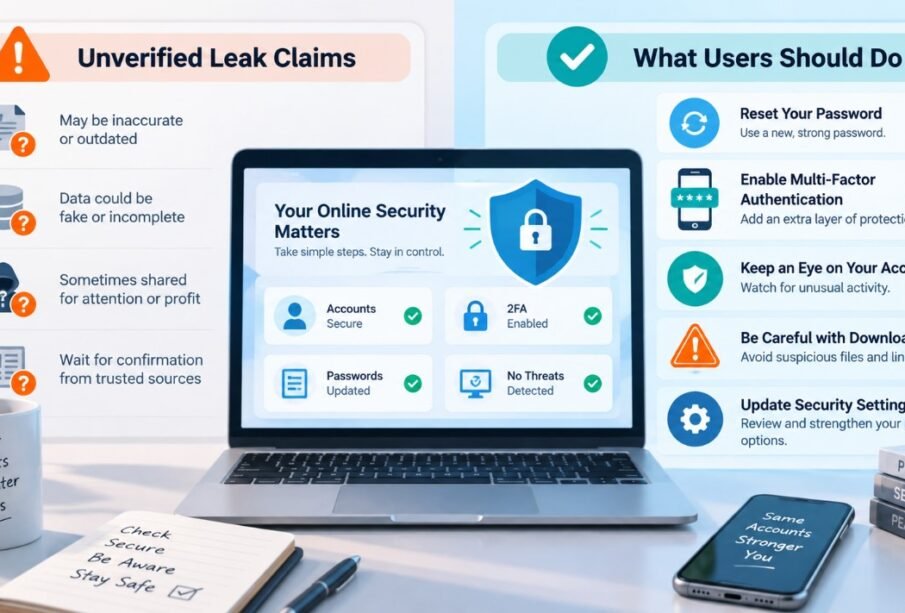
What Should You Do If You Are Worried About Your Data?
You do not need to download an alleged leak to protect yourself.
Start with the accounts that matter most, especially your primary email account, financial accounts, cloud services, and social-media profiles.
Change any password that has been reused across multiple websites. Ideally, each important account should have its own unique password.
Enable multi-factor authentication wherever it is available. CISA recommends MFA because an attacker who obtains a password still needs an additional authentication factor to access the account.
Check your account activity for unfamiliar logins, password-reset messages, changes to recovery information, or sessions from devices you do not recognize.
If an account may already have been compromised, change its password, sign out other sessions, verify the recovery email and phone number, and enable two-factor authentication. The FTC recommends these steps for recovering and securing hacked email and social-media accounts.
Where identity or financial information is genuinely exposed, users should follow the relevant breach-response guidance available in their country. In the United States, the FTC recommends actions based on the type of information exposed and may suggest measures such as monitoring financial activity, fraud alerts, or credit freezes in appropriate situations.
What Businesses Can Learn From Leak Discussions

Even an unverified leak story provides useful security lessons for organizations.
Companies should assume that passwords may eventually be exposed somewhere outside their control. That makes unique credentials, MFA, access controls, monitoring, and rapid account-revocation procedures important.
Businesses should also maintain an incident-response process before a breach occurs.
That process should establish who investigates suspicious activity, how compromised credentials are reset, how affected customers are notified, how evidence is preserved, and who communicates publicly.
Clear communication is especially important.
If an organization becomes associated with an alleged leak, a factual statement explaining what has and has not been confirmed can prevent speculation from becoming accepted as fact.
Why Accuracy Matters With Leak-Related Content
Cybersecurity reporting carries a higher responsibility than ordinary trend coverage.
Claiming that a company has suffered a breach without evidence can mislead readers. Publishing exaggerated record counts can create unnecessary fear. Repeating descriptions of supposedly leaked files without verification can make speculation look authoritative.
High-quality reporting should therefore use phrases such as “reported,” “alleged,” “unverified,” or “not independently confirmed” when the available evidence requires them.
Uncertainty is not a weakness.
When evidence is incomplete, clearly stating what is unknown is more useful than inventing certainty.
Conclusion
The most responsible interpretation of thejavasea.me leaks aio-tlp370 is straightforward.
The identifier is being discussed online, but its exact origin, contents, scale, and status as a distinct breach have not been reliably established through the authoritative evidence reviewed for this article.
“AIO” may mean All-In-One, while “TLP370” appears to be an informal identifier rather than an official Traffic Light Protocol designation.
For ordinary users, the practical response is not to hunt for questionable downloads. Protect important accounts, stop reusing passwords, enable MFA, watch for suspicious account activity, keep software updated, and rely on trustworthy breach notifications or security reporting.
That approach remains useful whether the archive eventually proves authentic, partially recycled, mislabeled, or something else entirely.
FAQs
Is AIO-TLP370 a confirmed data breach?
Not based on the authoritative information currently available. The term appears across multiple websites, but a verified affected organization, exact source, record count, and independent incident report have not been clearly established.
What does AIO mean in AIO-TLP370?
AIO commonly means “All-In-One” in technology terminology and can describe a bundle containing several files or resources. However, there is no reliable documentation confirming exactly what AIO means for this specific identifier.
Is TLP370 an official cybersecurity classification?
No. FIRST’s current Traffic Light Protocol recognizes TLP, TLP, TLP, and TLP. TLP370 is not an official TLP category.
Should I download AIO-TLP370 to check whether my information is included?
That is not necessary and can introduce additional risk. Unknown downloads may be unsafe. Instead, secure your accounts, change reused passwords, enable MFA, and use trustworthy breach notifications or official security information.
What should I do if I think one of my passwords was exposed?
Change the affected password immediately and change it anywhere else you reused it. Use unique passwords going forward, sign out unknown sessions, verify your recovery information, and enable multi-factor authentication.
Can information in a leak package be old?
Yes. Data collections can potentially contain material gathered or repackaged from older sources. A newly appearing filename or archive should therefore not automatically be interpreted as evidence of a newly occurring breach.
For more updates visit: PostFame



Leave a reply




The Rubik theme is the best Premium WordPress Themes that perfect for news, magazine, personal blog, etc. It’s never been easier to build a standout website.