
Target Company URL Research Explained for 2026
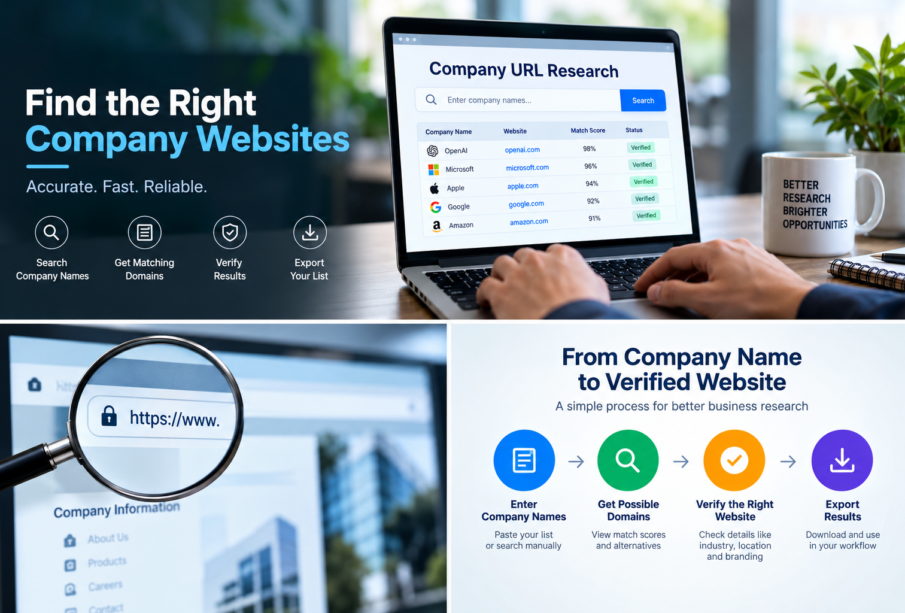
Finding and verifying official company website domains
Finding a company online sounds easy until your spreadsheet contains 100 business names, several companies share similar names, and half the search results lead to directories, social profiles, subsidiaries, or outdated websites.
That is where target company URL research becomes useful. Instead of treating a company name as enough information, the process identifies the most likely official domain and then verifies that the website really belongs to the organization you intended to research.
This matters for B2B sales teams, recruiters, market researchers, SEO professionals, lead-generation specialists, and anyone building a clean company database.
A dedicated tool at TargetCompanyURLResearch.com currently lets users paste company names and find matching domains in bulk. The site says its URL lookup supports up to 25 names per run, provides match scores and alternative candidates, allows CSV export, and requires no account or payment card.
But finding a likely domain and verifying a company are not exactly the same thing. Understanding that difference is what makes this research genuinely useful.
What Does Target Company URL Research Mean?
The simplest definition is:
It is the process of identifying and verifying the official website domain belonging to a target business.
Imagine receiving this prospect list:
- Bright Technologies
- Mercury
- Atlas Solutions
- Greenfield Systems
- Apex Consulting
Searching these names individually may produce dozens of possible matches. A common name such as “Mercury” could belong to businesses in finance, insurance, technology, manufacturing, or several other sectors.
The real goal is therefore not simply:
Company name → website
A safer workflow is:
Company name → possible domains → identity checks → verified company URL → business research
This distinction is important because a website appearing first in search results does not automatically prove it belongs to the company you need.
Why Finding the Correct Company URL Matters
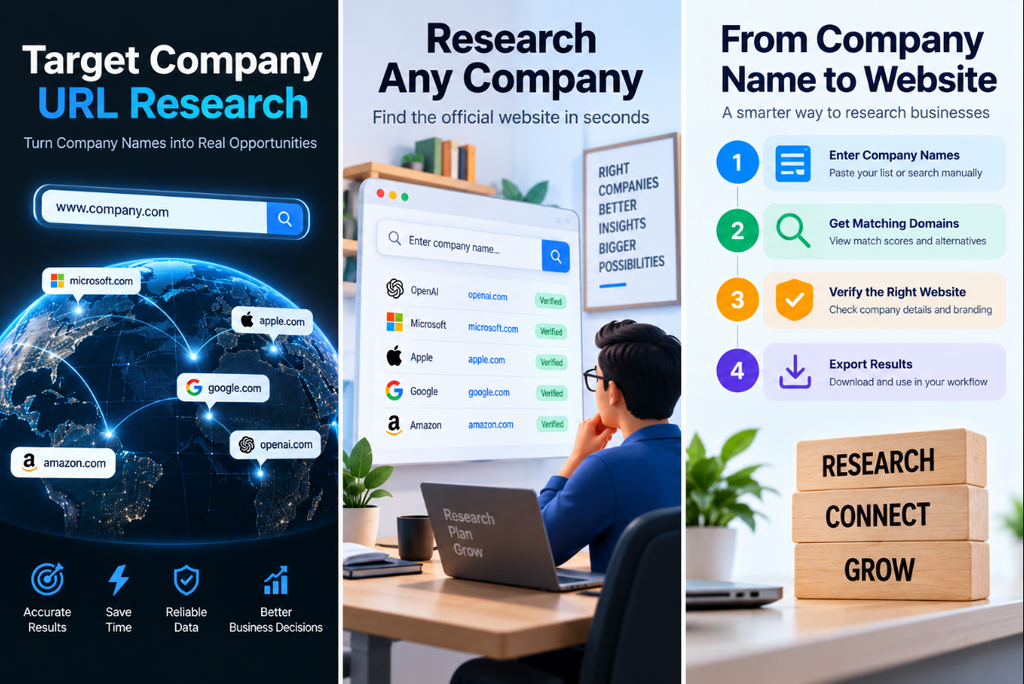
The official domain often becomes the foundation for everything that follows.
Once you have the correct website, you can research:
- Products and services
- Company positioning
- Locations
- Leadership
- Careers
- Contact information
- Industry focus
- Customer segments
- News and announcements
- Competitor positioning
For sales teams, an incorrect domain can contaminate CRM data and lead researchers toward the wrong company.
For recruiters, it can mean checking jobs at an unrelated organization.
For SEO professionals, the wrong domain can produce meaningless competitor keyword, traffic, and backlink comparisons.
For market researchers, a mistaken identity can affect an entire dataset.
The value of a company URL therefore comes from accuracy, not simply speed.
How Target Company URL Research Works
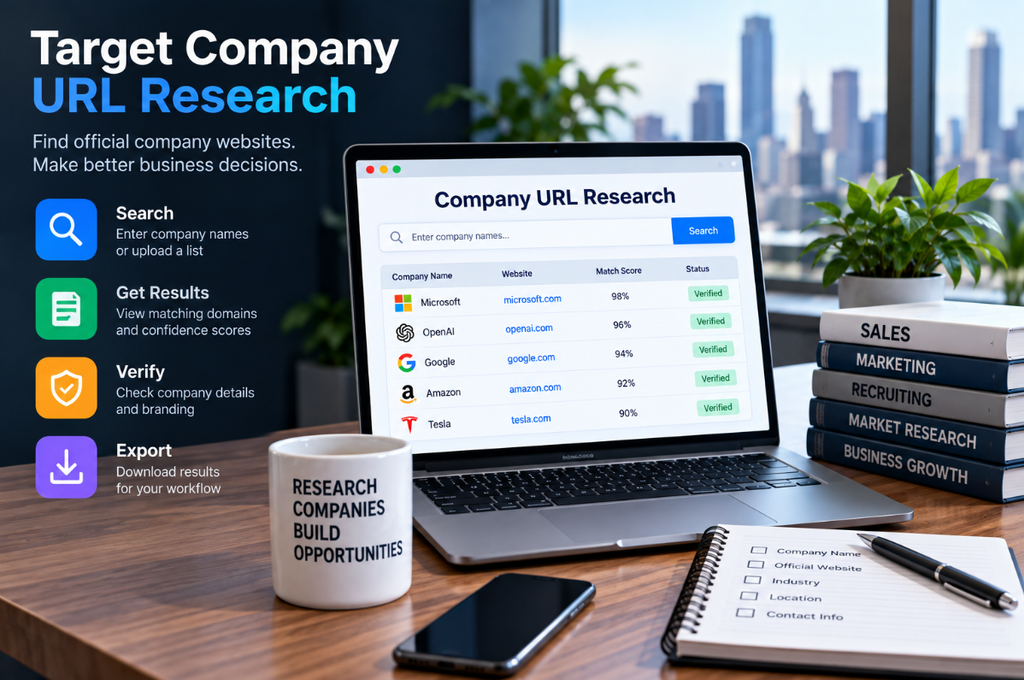
The current TargetCompanyURLResearch.com tool uses Clearbit Autocomplete as its underlying company-domain data source. According to the site, users can enter company names, review returned candidates, compare a match score, select alternatives where necessary, and export results.
The workflow is straightforward.
1. Prepare the Company Names
Start with the cleanest version of each company name available.
For example:
Instead of:
Example Technologies International LLC
you may get a better match from:
Example Technologies
Removing unnecessary legal suffixes such as LLC, Ltd, PLC, GmbH, or Inc can sometimes make company matching easier.
The tool says it performs some of this cleaning automatically.
2. Generate Candidate Domains
A company-name lookup service searches its database for businesses with similar names and returns likely domains.
The result might look conceptually like this:
| Input Company | Candidate Domain | Confidence |
|---|---|---|
| Example Labs | examplelabs.com | High |
| Mercury | mercury.com | Medium |
| Atlas Digital | atlasdigital.com | High |
The important word here is candidate.
Even a very close name match deserves verification before the domain is added permanently to a database.
3. Review Alternative Matches
Alternative candidates become especially important when researching short or common company names.
Names such as Atlas, Bolt, Mercury, Nova, Apex, or Pioneer may refer to many unrelated businesses.
Instead of accepting the first result automatically, compare:
- Company name
- Industry
- Location
- Products
- Branding
- Contact information
This small verification step can prevent much larger mistakes later.
What Does a Company Match Score Actually Tell You?
A match score is useful for prioritizing research, but it should not be treated as proof.
A strong score generally suggests that the company name you entered closely resembles the company name associated with the returned domain.
For example:
Greenfield Technology
and
Greenfield Technologies
would understandably appear closely related.
However, similar names can still belong to different legal entities.
A practical interpretation is:
| Match Level | Recommended Action |
|---|---|
| Very high | Perform a quick identity check |
| High | Open and confirm the website |
| Medium | Check industry, location and company details |
| Low | Review alternatives and research manually |
| No match | Use manual search or another data source |
Competitor guides covering this topic make the same important distinction: confidence scores help organize the research process, but they should not replace verification.
How to Verify an Official Company Website
This is where many basic company-domain guides stop too early.
A useful research workflow should confirm that the candidate domain really represents the target company.
Check the Branding
Does the homepage display the company name or brand you expected?
Minor naming differences are normal, especially when a legal entity operates under a shorter brand name.
Major differences deserve investigation.
Check the About Page
An About page can confirm:
- Industry
- Company history
- Headquarters
- Products
- Founders
- Markets served
Compare those details with what you already know about the target business.
Look at Contact Information
Check the company’s official contact page or footer.
Useful signals include:
- Corporate address
- Business email domain
- Telephone number
- Regional offices
If you expected a UK software business but the candidate belongs to a similarly named construction company in another country, you have probably found the wrong URL.
Check Legal and Privacy Pages
Privacy policies, terms pages, and legal notices often contain the formal company name behind a brand.
This can be particularly useful when the public brand and registered company name differ.
Cross-Check First-Party Profiles
If uncertainty remains, compare the candidate website with the company’s verified social or professional profiles.
Do not rely on a directory alone as final evidence when better first-party evidence is available.
Who Can Benefit From Company URL Research?
B2B Sales Teams
Sales researchers often begin with company names from events, directories, prospecting databases, referrals, or internal lists.
Finding the correct domain makes it easier to research a prospect before outreach.
A clean domain can later support:
- Account qualification
- Personalization
- Company enrichment
- Lead routing
- CRM deduplication
Recruiters and Job Seekers
A company domain is often the safest starting point for locating official employment information.
The researched tool includes a careers-page finder that creates common careers URL patterns. However, the site clearly warns that this feature does not confirm whether a company is hiring and that generated URLs may sometimes return a 404 page.
That distinction is valuable.
A URL pattern generator saves time, but the company’s own navigation remains the more reliable source for current vacancies.
SEO Professionals
Company-domain discovery can be the beginning of competitor analysis.
A typical SEO workflow might be:
Competitor names → official domains → SEO platform → keyword comparison → backlink research → content analysis
A URL finder identifies the website. It does not automatically provide reliable organic traffic, backlink, ranking, authority, or keyword data.
Those require dedicated SEO research tools.
Market Researchers
Researchers creating industry or geographic company lists can use domain identification to organize businesses and then inspect first-party information.
This can help with:
- Market mapping
- Competitor discovery
- Category analysis
- Regional research
- Company profiling
Company URL Finder vs Manual Search vs Enrichment Platform
Different methods suit different workloads.
| Method | Best For | Main Advantage | Main Limitation |
|---|---|---|---|
| Manual search | Small lists | Maximum human control | Slow |
| Free URL finder | Small to medium batches | Fast domain discovery | Requires verification |
| Paid enrichment platform | Large commercial workflows | More company attributes and integrations | Usually paid |
| Direct company research | High-value accounts | Deeper context | Time intensive |
The best workflow is often hybrid.
Use automation to generate candidates, then use human verification where the result is ambiguous or commercially important.
Important Limitations to Understand
No company lookup system should be treated as perfectly accurate.
Common problems include:
- Companies with identical names
- Recently changed domains
- Mergers and acquisitions
- Regional domains
- Parent companies and subsidiaries
- Brands operating under another legal name
- Companies with limited web presence
- Outdated third-party database records
There is also an important technical point about the data source used by the current free tool.
Clearbit’s official support documentation says its Autocomplete API remains free and does not require an account or API key. However, Clearbit describes its older free APIs as legacy products and notes limited support, meaning workflows depending on them should not assume that their availability or behavior can never change.
That makes manual verification and fallback methods worth keeping in any serious workflow.
Best Practices for More Accurate Results
Several habits can significantly improve company research quality:
- Start with clean company names.
- Remove unnecessary legal suffixes when appropriate.
- Add industry or location context when a name is ambiguous.
- Never treat a match score as absolute proof.
- Open medium- and low-confidence matches manually.
- Check alternative candidate domains.
- Verify important records before CRM import.
- Keep the source and verification date with valuable datasets.
- Recheck domains periodically because companies can rebrand or migrate websites.
For high-value prospects, spend more time verifying.
For a simple exploratory list, bulk matching may be enough to identify candidates before deeper research begins.
Is the Tool Worth Using?
For users who simply need to turn a modest list of company names into possible domains, the current free tool provides a useful starting point.
Its strongest features are simplicity, bulk lookup, alternative candidate results, match scoring, careers-path generation, and CSV export. It also states that no account or card is required.
Its biggest limitation is shared by nearly every automated domain finder: a returned domain is only as useful as the match behind it.
A good researcher therefore uses automation for discovery and evidence for verification.
Conclusion
Used correctly, target company URL research is a simple but important step in B2B prospecting, recruiting, SEO analysis, and market research.
The objective is not to collect as many URLs as possible. It is to connect each business name with the correct official domain while keeping uncertain matches visible rather than hiding them.
Automation can dramatically reduce repetitive searching, especially when working with lists. Human judgment still matters when names are ambiguous, records are outdated, or the company is important enough that an error would affect later decisions.
Start with a candidate domain, verify the identity, and only then treat the website as a dependable research source.
FAQs
What is a target company URL?
A target company URL is the official website address associated with a business you want to research, contact, recruit from, analyze, or add to a prospecting database.
Can I find a company website using only its name?
Often, yes. Company-domain lookup tools and search engines can generate possible matches from a business name. Common or ambiguous company names usually require additional verification using location, industry, branding, and contact information.
Is a high match score proof that a domain is correct?
No. A high score normally indicates a strong similarity between names. It does not independently prove that the returned website belongs to the exact organization you intended to research.
Can company URL lookup help with SEO competitor research?
Yes. Once competitors’ official domains are identified, those domains can be analyzed with dedicated SEO platforms for keywords, rankings, backlinks, content gaps, and other metrics.
Can a URL finder show whether a company is currently hiring?
Not necessarily. Some tools can locate or generate possible careers-page URLs, but current vacancies should be verified on the company’s official careers section or applicant tracking system.
Should I verify every domain manually?
For high-value accounts and uncertain matches, yes. Large lists can be prioritized by confidence level so that obvious matches receive a quick check while ambiguous results receive deeper research.
For more updates visit: Postfame




1 comment
Leave a reply




The Rubik theme is the best Premium WordPress Themes that perfect for news, magazine, personal blog, etc. It’s never been easier to build a standout website.
[…] should therefore avoid assuming that every biography or business claim repeated by third-party websites has been independently […]